


Here we go with session #2, where I will research the topic of the Dead Sea Scrolls. I've always heard the stories about these scrolls and generally knew they were important historical documents related to the Bible, but I never paid attention to the details. The scrolls are scientifically recognized as being parts of the Bible plus more. The research on this topic taught me a lot about the Scrolls, where they were found, when, and who found them. Unfortunately, because of our Mainstream Media, many people are unaware of this discovery, which is part of why I'm doing this session. The finding of these scrolls is a massive story that people should know about.
So, what exactly are the Dead Sea Scrolls? They are documents or manuscripts found between ~1947 and 1956, primarily in caves around Qumran in the West Bank. The majority of the Dead Sea Scrolls are religious documents, but some are non-biblical—the image below shows where Qumran is for those who don't know. Truthfully, I tell you I didn't know and learned something new.
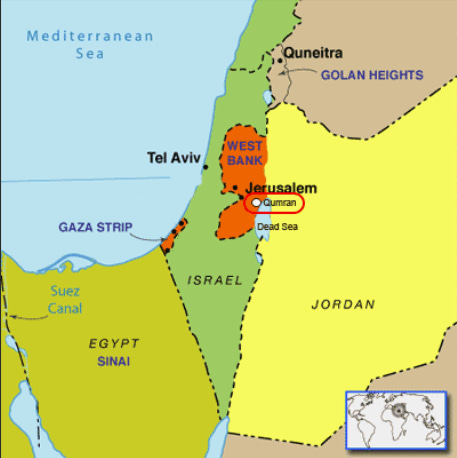
Let's take it down a level and review the actual locations of the caves, which were spread over a wide area. Note that the image below only shows 11 of the 12 sites where the scrolls were found. I could not find a map with all 12.

http://mybiblicalstudy.weebly.com/dead-sea-scrolls.html
The scrolls were stored in jars and buried to save them, maybe for history or their own safety. Remember, Jews were not loved by most during this time, and the Romans were not friends, and to be caught with scripture could be death.
The amount of scripture discovered is incredible. Archaeologists and many others have worked for many years restoring these scrolls piece by piece. Review the table below, which comes from Wiki, to give you an idea of the amount of material found. This is a lot of material, a lot more than I expected.

The following images are to give you an idea of what these items looked like:

It's incredible how people found and entered these caves, and I wonder how many other locations will provide additional findings. I have been seeing periodic articles on many other findings unrelated to the scrolls, and I will be covering those through future sessions. It's too bad the media doesn’t spend much time informing others about the Dead Sea Scrolls and other significant religious findings, because they stay away from religion.

ttps://www.deadseascrolls.org.il/featured-scrolls
The following specifics are from Grok AI, with the references at the end.
"The Dead Sea Scrolls ... are among the most significant archaeological finds of the 20th century, shedding light on ancient Judaism, the origins of Christianity, and the textual history of the Hebrew Bible.
Contents of the Dead Sea Scrolls
The scrolls, numbering over 900 documents (many fragmentary), are written primarily in Hebrew, with some in Aramaic and Greek. They can be grouped into three categories:
Biblical Manuscripts (~40% of the scrolls)
Apocryphal and Pseudepigraphal Texts (~30%):
These include non-canonical works like the Book of Enoch, Jubilees, and Tobit, which were revered by some Jewish groups but excluded from the later Jewish canon.
Sectarian Texts (~30%):
These reflect the Qumran community’s beliefs, rules, and practices.
Significance of the Dead Sea Scrolls
The scrolls offer a window into the religious, cultural, and textual landscape of Second Temple Judaism, with implications for understanding the Bible’s formation and authenticity.
Textual History of the Hebrew Bible
Textual Fluidity: The scrolls show that the Hebrew Bible’s text was not fully standardized in this period. Different versions of books (e.g., Jeremiah’s shorter Septuagint-like version vs. the longer Masoretic one) circulated simultaneously. This supports the idea that biblical texts were edited and shaped over time, as discussed in your earlier question.
Canon Formation: The presence of multiple biblical books suggests a core canon (e.g., Torah, Prophets) was widely accepted by the 2nd century BCE. However, the inclusion of apocryphal texts indicates ongoing debates about which books were authoritative, aligning with the gradual canonization process (c. 400 BCE–200 CE).
Stability and Variation: While some scrolls (e.g., Isaiah) are nearly identical to later texts, others show minor differences in wording, spelling, or content. These variations rarely affect core theological claims but highlight scribal flexibility.
Insights into Ancient Judaism
Connections to Christianity
New Testament Context: The scrolls predate Christianity but illuminate its Jewish roots. Terms like "Son of Man" and eschatological themes in the scrolls echo Gospel language, though direct influence is debated.
John the Baptist Theory: Some speculate John the Baptist had ties to the Qumran community due to his asceticism and proximity to the Dead Sea, but no scroll explicitly confirms this.
Non-Christian Nature: Despite early sensational claims, the scrolls are Jewish, not Christian, documents. They mention no New Testament figures or events.
Archaeological and Historical Corroboration
Historical Anchors: The scrolls align with known historical contexts, like Hellenistic influence (e.g., references to Greek rulers in 1 Maccabees) and Roman occupation. This supports the historicity of the Second Temple setting.
Material Evidence: The scrolls’ physical state—leather, papyrus, ink—matches 1st-century BCE–CE scribal practices, confirming their authenticity as ancient artifacts.
Implications for the Bible’s Authenticity
Tying back to your question about whether Bible stories are "fake," the Dead Sea Scrolls provide critical evidence:
Support for Historicity:
The close alignment of many scrolls with the Masoretic Text, despite being 1,000 years older, confirms the Hebrew Bible’s textual stability. For example, the Great Isaiah Scroll is 95% identical to later versions, with differences mostly in spelling or minor phrasing.
The scrolls’ historical references (e.g., to Seleucid rulers) ground biblical narratives in real settings, reducing the likelihood of wholesale fabrication.
The multiplicity of Psalms copies suggests their liturgical use, implying cultural authenticity even if specific events (e.g., David’s life) are hard to verify.
Symbolic vs. Historical Truth:
The scrolls reinforce that many biblical texts blend history and theology. For instance, the War Scroll’s battle narrative is likely symbolic, not historical, much like Revelation’s visions. This supports viewing some Bible stories (e.g., Creation, Jonah) as meaningful but not necessarily factual.
The Qumran community’s intense scriptural engagement suggests they valued texts for spiritual guidance, not just historical accuracy, aligning with how many modern readers approach the Bible.
No Evidence of Fabrication:
Nothing in the scrolls suggests deliberate deceit. Variations reflect scribal practices or theological diversity, not conspiracies to invent stories. The scrolls’ age and context make them credible witnesses to ancient beliefs.
Controversies and Modern Study
Access and Publication: After their discovery, the scrolls were controlled by a small scholarly team, leading to delays in publication. By the 1990s, public pressure and digital imaging made them widely accessible. Today, the Israel Antiquities Authority oversees their preservation, with many digitized at the Leon Levy Dead Sea Scrolls Digital Library.
Forgeries: Some fragments sold on the black market post-1947 were later deemed forgeries. However, the core Qumran finds remain authentic.
Ongoing Debates: Scholars debate the Qumran community’s identity (Essenes vs. others), the scrolls’ origins (local vs. external), and their precise impact on Christianity. New technologies, like multispectral imaging, continue to reveal faded texts.
Grok Conclusion
The Dead Sea Scrolls are a treasure trove of ancient Jewish texts, offering unparalleled insight into the Hebrew Bible’s textual history, Second Temple Judaism, and the cultural soil of early Christianity. They confirm the antiquity and relative stability of biblical texts while highlighting their fluidity and diversity before canonization. Regarding your question about the Bible’s stories being "fake," the scrolls suggest that while some narratives are symbolic or edited, they reflect genuine cultural and religious traditions, not fabrications. They anchor the Bible in a historical context, though interpretive questions remain. If you want to explore specific scrolls, their theological implications, or related archaeological debates, let me know!"
My conclusion: Using AI is getting easier all the time. It is pretty accurate and can provide references if requested. I don’t mind using AI to gather the data because the algorithm goes over massive amounts of information in a short period of time—something that takes me weeks, if not months. It helps speed up the research, and I am sure all college students are using some sort of AI as well.
My goal for these sessions is to inform you based on what I can find about a given topic. The Dead Sea Scrolls were hidden from the public for many years, most likely because of the difficulty of putting pieces together and analyzing all the physical findings. But maybe there was also fear—fear of discovering material that is not currently written or that counters what is in the Bible—something to think about.
I hope you enjoyed this. There is so much more to learn about these scrolls, and there are plenty of books out there to expand your knowledge. Thanks, and be safe.
Dead Sea Scrolls References
Davies, P. R., Brooke, G. J., & Callaway, P. R. (2002). The Complete World of the Dead Sea Scrolls. Thames & Hudson.
Comprehensive overview of the Scrolls’ discovery, contents, and significance.
ISBN: 9780500051115
Schiffman, L. H. (1994). Reclaiming the Dead Sea Scrolls: The History of Judaism, the Background of Christianity, the Lost Library of Qumran. Jewish Publication Society.
Details the Scrolls’ textual diversity and Qumran community’s beliefs.
ISBN: 9780827605305
Tov, E. (2010). Textual Criticism of the Hebrew Bible (3rd ed.). Fortress Press.
Analyzes the Scrolls’ biblical manuscripts, showing textual fluidity and stability.
ISBN: 9780800696641
Ulrich, E. (2015). The Dead Sea Scrolls and the Developmental Composition of the Bible. Brill.
Explores how the Scrolls reveal the Hebrew Bible’s editorial history.
DOI: 10.1163/9789004296039
VanderKam, J. C., & Flint, P. W. (2002). The Meaning of the Dead Sea Scrolls: Their Significance for Understanding the Bible, Judaism, Jesus, and Christianity. HarperOne.
Connects the Scrolls to biblical canonization and early Christianity.
ISBN: 9780060684655
Ehrman, B. D. (2022). "Did King David Actually Exist?" The Bart Ehrman Blog.
Summarizes Dever’s views on David’s historicity, citing Tel Dan and Qeiyafa.
Israel Antiquities Authority. (2025). "The Leon Levy Dead Sea Scrolls Digital Library."
Official digitized archive of the Scrolls, used for textual analysis.
URL: https://www.deadseascrolls.org.il/
Reddit Community (2018). "r/AskHistorians: Why is the story of David and Bathsheba not mentioned in Chronicles?"
Public discussion on textual shaping, referenced for editorial insights.
URL: https://www.reddit.com/r/AskHistorians/comments/8j3k2p/why_is_the_story_of_david_and_bathsheba_not/
Stavrakopoulou, F. (2021). "The Historical David: Myth or Reality?" The Guardian (Online).
Minimalist perspective questioning David’s kingdom, cited for balance.
URL: https://www.theguardian.com/books/2021/sep/05/god-an-anatomy-francesca-stavrako